FrequentlyAskedQuestions
OOn this page, you will find an overview of the most frequently asked questions regarding the Textus Receptus. From the origin of the term to comparisons with modern critical texts: we aim to provide clarity on the complex matter of biblical text transmission.
General Concepts
The term 'Textus Receptus' (Latin for 'Received Text') was first used in the preface of an edition by the Elzevier brothers in 1633. It refers to the standard Greek text of the New Testament that was 'received' and used by the church for centuries as the basis for Reformation Bibles.
Without the printing press (ca. 1450), the spread of the TR would have been impossible. Previously, Bibles were handwritten, leading to variations per copy. The printing press ensured a uniform, standardized text that could be reproduced thousands of times and spread across Europe.
The Vulgate is a Latin Bible translation made by Jerome around 382 AD. It was the official Bible of the Roman Catholic Church. Reformers opposed it because they wanted to return to the original Greek source text (the TR) instead of a translation they believed had deviated from the source.
No, it is a textual tradition consisting of various editions that are very similar. Well-known editions include those by Erasmus, Stephanus (1550), Beza, and the Elzeviers.
Textual Basis
This is the group of manuscripts copied and used in the Greek-speaking church during the Byzantine Empire (ca. 330-1453). Over 90% of all discovered Greek manuscripts belong to this family. The TR is a printed representation of this broad stream of manuscripts.
The TR is based on the Byzantine text family, also known as the 'Majority Text'. Erasmus used a handful of manuscripts available to him in Basel for his first edition, but later editions were refined with more sources within the same tradition.
The critical text (such as Nestle-Aland) relies primarily on a small number of very old manuscripts (like Codex Sinaiticus and Vaticanus). The TR follows the text preserved in the vast majority of Byzantine ecclesiastical manuscripts over the centuries.
Translations & Reformation
The Dutch Statenvertaling translators chose the TR by order of the Synod of Dort because they saw it as the most reliable text of the New Testament, preserved by God. They wanted a translation that went directly back to the Greek source text, independent of the Latin Vulgate used by the Roman Catholic Church.
The choice for the TR by translators like Luther (German), Tyndale, the King James translators (English), and Reina-Valera (Spanish) was based on three fundamental reasons:
- Accessibility: The TR was at that time the only generally available, printed Greek text presented as a complete and coherent whole.
- Providence: The Reformers believed that God had preserved the biblical text through the centuries in the living church (Providentia Dei). The TR represented the text used by the Greek-speaking churches until the late Middle Ages.
- Anti-Vulgate: There was a strong theological urge to return to the 'Fontes' (the sources). The TR allowed them to demonstrate where church tradition had deviated from the original apostolic teaching.
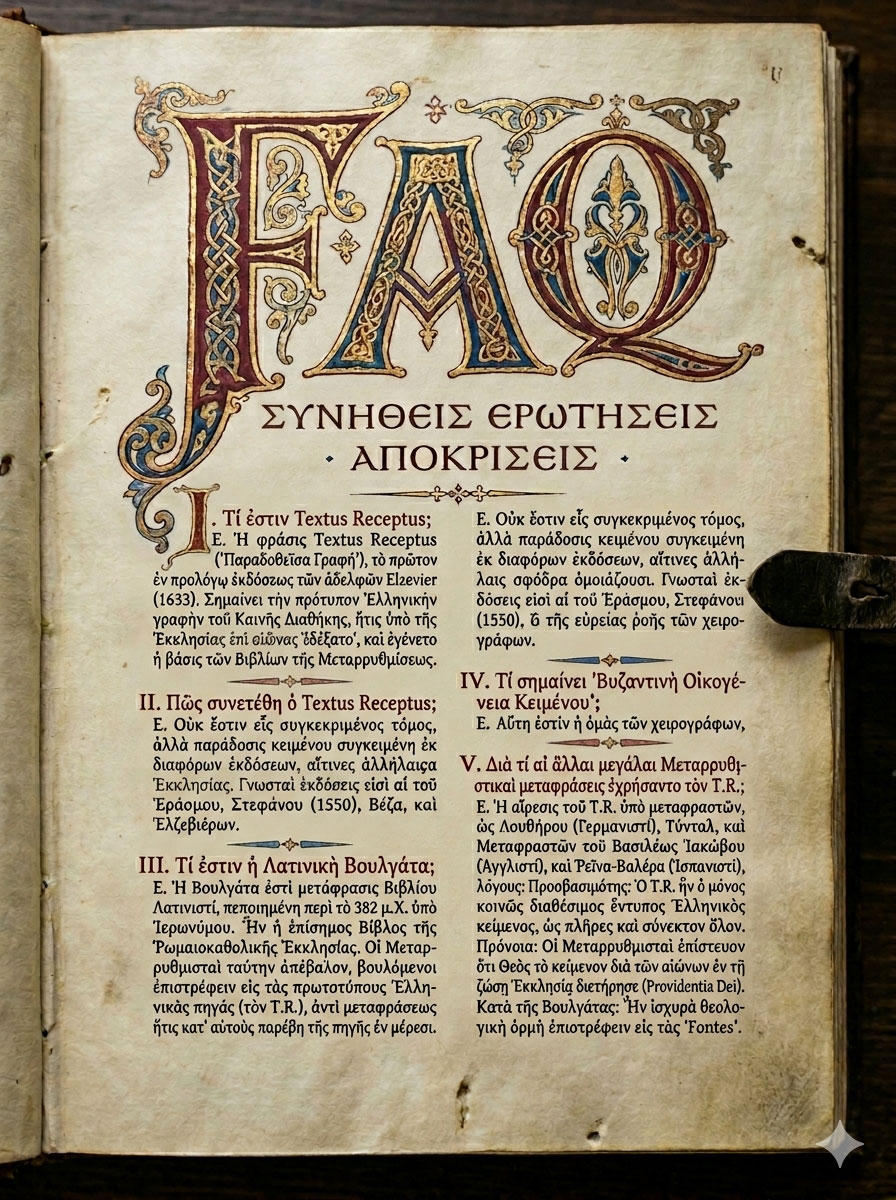
Frequently Asked Questions
Description of the FAQ
FAQ and the Bible
In the times of the New Testament, there were no web pages with FAQs as we know them, but there were frequently asked questions.
Jesus Christ
In the gospels, Jesus of Nazareth is regularly approached with recurring questions about subjects such as the Sabbath, marriage, and eternal life (e.g., in the Gospel according to Matthew 19 and 22).
Paul of Tarsus
This is also recognizable in Paul's letters. In First Corinthians, he systematically addresses questions from the congregation, such as about marriage, food, and spiritual gifts (1 Corinthians 7–8 and 12).
Further...
In the New Testament, answers to recurring questions appear in several places. In the letters of Paul of Tarsus, practical and faith questions are discussed, such as in 1 Corinthians 7–8 and 12, Romans 6 and 9, and 1 Thessalonians 4. Other letters also address recurring themes, such as James 1–3, Hebrews 4–10, and 1 John 1–5. Additionally, Acts 15 addresses a recurring question within the early church. Thus, the New Testament shows that fixed answers were formulated early on for questions that lived again and again.