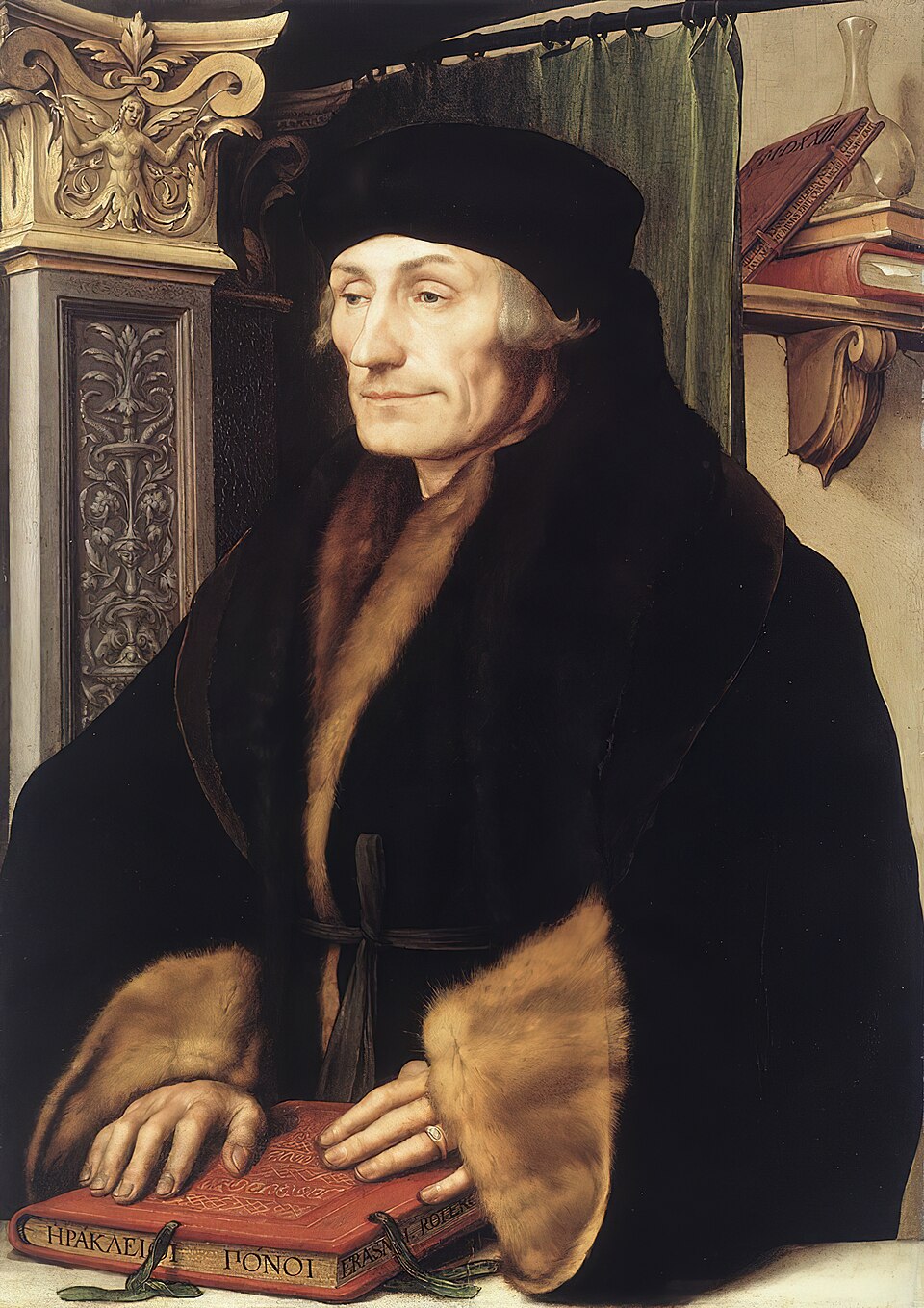
Desiderius Erasmus was a man of letters, a tireless traveler through Europe, and above all a visionary humanist. At a time when the Latin Vulgate was considered infallible, Erasmus dared to question the accuracy of Bible translations that had been in use for a thousand years.
TheScholar
Desiderius Erasmus Roterodamus (c. 1466–1536) was one of the most influential thinkers of Northern Europe. As a Christian humanist, he dedicated his life to the restoration of classical literature and the study of the original biblical text.
His erudition and sharp pen earned him the title "Prince of the Humanists." He traveled throughout Europe — from Rotterdam to Leuven, Paris, Oxford, and Basel — and corresponded with the greatest thinkers of his time.
AdFontes
His motto, Ad Fontes (back to the sources), summarized his life's work. Erasmus believed that God could only be truly understood by studying the texts in their original languages. In 1516, he published his Novum Instrumentum omne, the first printed edition of the Greek New Testament.
"I would that even the lowliest woman should read the Gospels and the Epistles of St. Paul. I wish they were translated into all languages, so that they might be read and known, not only by Scots and Irishmen, but also by Turks and Saracens."
TheGreekText
For the compilation of his Greek text, Erasmus used six different manuscripts he found in Basel. Although these manuscripts were not the oldest, they formed a consistent tradition later known as the Byzantine text. This work became the basis for the famous Textus Receptus.